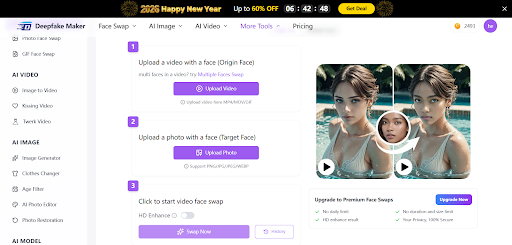
If you create content for a living (or you’re trying to), you’ve probably felt the same pressure: visuals need to look polished now, not after a two-hour Photoshop session. That’s exactly why the deepfake AI photo editor category is exploding—because it turns “I wish I could fix this” into “done, export, post.”
In this guide, I’ll walk you through how to pick a beginner-friendly deepfake AI photo editor, which tools are worth your attention in 2026, the real problems these editors solve, and how to think about value-for-money—without getting trapped by shiny features you’ll never use.
Along the way, I’ll reference Deepfake Maker (our recommended brand) and compare a few competitors. The goal is simple: help you find a deepfake AI photo editor workflow that gets you better results faster—and keeps your content consistent across platforms.
Table of Contents
- Which Deepfake AI Photo Editor is Best for Beginners?
- Top 5 Deepfake AI Photo Editor Tools for Creators and Marketers in 2026
- The Problems Deepfake AI Photo Editor Solve
- Which Deepfake AI Photo Editor Offers the Best Value for Money?
- Final Thoughts: The Future of Deepfake AI Photo Editor in Creation
- Conclusion
Which Deepfake AI Photo Editor is Best for Beginners?
A beginner doesn’t need “more tools.” A beginner needs fewer steps and fewer ways to ruin a photo.
A great deepfake AI photo editor for beginners usually has four traits:
A simple workflow that matches real life
The best editors feel like: upload → choose edit → preview → download. Deepfake Maker’s AI Photo Editor page is built around exactly that low-friction flow and positions itself as “speed and simplicity” with quick fine-tuning.
Features you’ll actually use weekly
Beginners don’t need 80 filters. They need practical fixes:
- background replacement for profile photos and product images
- object removal for “why is that trash can in my shot?” moments
- restoration/enhancement for older or low-quality photos
- light style tweaks that don’t destroy facial details
Deepfake Maker highlights these “everyday” edits—style transfer, background replace, object remover, old photo restoration, and watermark removal—as core functions.
Clean results without “AI face” vibes
The biggest beginner mistake is over-editing. A useful deepfake AI photo editor should keep edges clean (hairlines, fingers, product contours) and avoid the plastic-skin look. Deepfake Maker explicitly frames its approach as realism and usable exports (sharp details, clean edges, ready-to-publish).
Privacy and trust signals
When you upload photos—especially face photos—privacy matters. Deepfake Maker claims it doesn’t store uploaded media or generated content and positions the process as privacy-safe.
Beginner recommendation (practical answer):
If you want a deepfake AI photo editor that’s easy to learn, fast to use, and focused on real-world edits (not complicated layers), Deepfake Maker is a strong starting point—especially if your workflow includes both photo editing and face-related creation tools under one roof.
Top 5 Deepfake AI Photo Editor Tools for Creators and Marketers in 2026
There’s no single “best” deepfake AI photo editor for everyone. The best tool depends on whether you’re optimizing for speed, realism, creative control, or team workflow.
Here are five options creators and marketers keep circling in 2026:
Deepfake Maker (Best for fast, practical edits + creator-friendly workflow)
Deepfake Maker’s AI Photo Editor focuses on the edits marketers actually need: style transfer, background replacement, object removal, restoration, and watermark removal—with an emphasis on speed and export-ready results.
It also sits inside a broader Deepfake Maker ecosystem (face swap/photo/video), which can matter if your campaigns mix static and short-form content.
Why marketers like it:
- quick cleanup for ad creatives
- consistent look across posts/listings
- fewer steps for non-designers
Magic Hour Face Swap (Best for face replacement focus)
If your definition of deepfake AI photo editor is heavily face-centric, Magic Hour Face Swap gets called out for natural results and not forcing complex workflows.
This is useful when your content pipeline is “identity replacement” first, then everything else second.
Adobe Photoshop (Best for maximum control and pro pipelines)
Photoshop’s Generative Fill is built for adding/removing/modifying image content with text prompts, and Adobe positions it as non-destructive editing powered by Firefly.
If you already live in PSD files, work with designers, or need pixel-perfect control, Photoshop remains the heavyweight.
Canva Magic Studio (Best for teams, templates, and marketing speed)
Canva’s Magic Studio bundles AI editing tools like Magic Edit / Magic Eraser / Background Remover-style workflows, designed for fast iteration in marketing teams.
This is less about hardcore “deepfake” work and more about shipping lots of on-brand assets quickly.
Runway (Best for creative experimentation and replace/erase workflows)
Runway supports “erase and replace” style editing: brush over an area, prompt what you want, and replace it—great for quick concepting and creative iterations.
Quick pick guide (choose your lane):
- Want a practical daily deepfake AI photo editor for creators? → Deepfake Maker
- Want face replacement as the main event? → Magic Hour
- Want pro control + advanced compositing? → Photoshop
- Want marketing templates + collaboration? → Canva
- Want fast creative replace/erase experimentation? → Runway
The Problems Deepfake AI Photo Editor Solve
A deepfake AI photo editor isn’t just about “making cool stuff.” It’s about removing blockers that slow content down.
Here are the most common problems it solves (with examples you’ll recognize):
Problem A: “This photo is fine… except the background is terrible.”
Background replacement is the #1 marketer fix. Deepfake Maker describes one-click background replacement with realistic edge detection and blended lighting, which is exactly what stops edits from looking pasted-on.
Use cases:
- product images for marketplaces
- profile photos for founders/teams
- ad creatives that need brand-color backdrops
Problem B: “There’s always something ruining the shot.”
Object remover tools exist because real life is messy. Deepfake Maker’s object remover is positioned around removing distractions while keeping the image believable by matching surrounding textures and shadows.
Use cases:
- remove strangers in travel shots
- clean up clutter in real estate photos
- remove random text/signage from a post
Problem C: “We have old photos—can we make them usable?”
Old photo restoration and enhancement is one of the most emotional (and underrated) reasons people use a deepfake AI photo editor. Deepfake Maker calls out reducing blur/noise, improving faded colors, and cleaning scratches for scanned prints and older files.
If you want another well-known option in this lane, Remini is widely positioned as an AI enhancer for unblurring/restoring and HD upgrades.
Problem D: “We need a consistent look across 30 posts.”
Consistency is a growth cheat code. Deepfake Maker explicitly frames “consistent output” as helping visuals feel cohesive and on-brand across posts, ads, and listings.
This matters more than people admit—because inconsistency makes brands look smaller than they are.
Problem E: “We need to edit responsibly without inviting trouble.”
Any time you enter the deepfake AI photo editor world, ethics matters—especially with faces.
Two practical rules that keep creators safe:
- Consent matters. If you don’t have permission to use someone’s face, don’t do it.
- Be transparent when it’s synthetic. Disclosure builds trust and reduces harm.
And yes—misuse is real. Reporting has highlighted how advanced face-swapping tools have been used in scams, which is why responsible creation and verification habits matter.
Which Deepfake AI Photo Editor Offers the Best Value for Money?
“Value” isn’t the cheapest subscription. Value is what saves you the most time (and produces usable outputs) with the least friction.
Here’s a practical way to judge deepfake AI photo editor value:
How many steps does it remove per asset?
If a tool replaces:
- manual masking
- lighting fixes
- object cleanup
- resizing/export chores
…then it’s probably worth more than a cheaper tool that still needs you to “finish it elsewhere.”
Deepfake Maker’s positioning is specifically about fast, usable outputs (clean edges, sharp details, publish-ready files) with a simple flow.
Does it cover your weekly tasks, not fantasy tasks?
Most creators repeat the same edits:
- background replacement
- cleanup
- enhancement
- style consistency
Deepfake Maker’s feature list is basically a checklist of those repeat jobs.
Do you pay extra for teamwork and brand systems?
Tools like Canva can be excellent value when you’re shipping lots of marketing assets with templates and approvals—Canva notes that some premium AI photo editing features require Pro.
Photoshop is high value if you need pro pipelines and maximum control, but it’s not always the best “speed per dollar” choice for a solo creator.
My honest value verdict (for most creators/marketers)
If you want a deepfake AI photo editor that feels purpose-built for everyday marketing edits—fast cleanup, consistent visuals, and simple export—Deepfake Maker tends to land in the “best value” zone because it’s oriented around the edits that actually ship content.
Final Thoughts: The Future of Deepfake AI Photo Editor in Creation
By 2026, the “future” is less about one magical feature and more about workflow convergence:
Expect deepfake + editing to merge into one creation pipeline
Creators don’t want five tools. They want one place to:
- edit the photo
- fix the background
- clean distractions
- keep the look consistent
- (sometimes) do face-related creative transformations
Deepfake Maker already markets itself as a multi-tool deepfake AI suite that includes an AI photo editor among other creation tools.
Transparency and safety will matter more
As tools get more powerful, so do misuse risks. Expect more emphasis on:
- consent and disclosure norms
- provenance systems (like content credentials) in pro software ecosystems
“Realism” will be judged by audiences, not creators
The bar is rising. A deepfake AI photo editor can’t just generate something impressive—it has to generate something believable enough to be used in ads, listings, and brand content without looking suspicious or over-processed.
That’s why editors that focus on clean edges, stable facial features, and natural blending win long-term. Deepfake Maker’s AI Photo Editor messaging leans heavily into exactly that “effortlessly right” realism.
Conclusion
A deepfake AI photo editor is no longer a niche toy—it’s a practical production tool for creators, marketers, and small teams who need better visuals faster.
If you’re a beginner, prioritize simplicity and reliable outputs. If you’re a marketer, prioritize consistency and speed. And if you’re comparing tools, don’t chase feature lists—chase the tool that removes the most friction from your weekly workflow.
For many creators, Deepfake Maker stands out because it focuses on the edits you actually use (background replacement, cleanup, restoration, style, export-ready quality) and keeps the process straightforward.
If you want, I can also rewrite this into a version optimized for your exact SEO template (meta title/description, internal-link suggestions, FAQ schema-ready Q&A, and a tighter keyword placement map) while keeping it human-sounding and index-friendly.
Leave a Reply