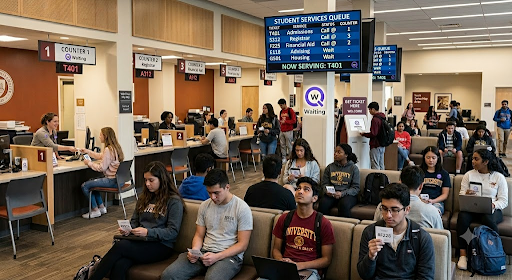
It’s Monday morning, new admissions enrollment week. A student drives an hour to campus, walks into the registrar’s building, and joins a line that hasn’t moved in twenty minutes. Nobody tells her how long it’ll be. She asks a staff member, who looks as stressed as she does. By lunchtime, she gives up. Leaves. Comes back two days later.
She didn’t drop out. But something shifted that week. A small, quiet erosion of confidence in the institution she just committed four years to.
This happens everywhere, every semester. And most universities don’t track it because there’s no system to track it with.
But this should not be a problem anymore. In 2026, lines can be avoided as more universities are now investing in smart education queue systems, which not only reduce students’ wait times but also ensure a quick and seamless admission onboarding. Let’s see how these systems actually work.
What Unmanaged Service Queues Are Actually Costing You
The real cost of queue chaos never appears on a report, which is exactly why it never gets fixed. Here’s how it impacts the growth:
It Doesn’t Show Up on Any Report — That’s the Problem
Most of the cost is invisible, which is exactly why it persists. Start with staff time. On a busy morning, how much of a front-desk team’s day goes toward crowd management rather than actual service? Answering “how long is the wait” fifteen times an hour. Manually logging walk-ins. Rescheduling no-shows. Chasing students who left without being served. None of that appears on a budget report. It just disappears into the workday.
Students Are Absorbing a Cost You Can’t See Either
Long, unmanaged queues aren’t just inconvenient. For students, that feels chaotic and adds real stress on top of everything else they’re carrying. This rarely surfaces in satisfaction surveys with enough specificity to trigger action. It just shows up as a general feeling that the institution is hard to deal with.
No Data Means No Way to Improve
When queues aren’t managed through a system, nothing is recorded. No average wait times. No peak period breakdowns. No service type analysis. Decisions get made on gut feel, and problems persist longer than they should. Administrators who want to improve service can’t build a case because there’s no evidence base to build from.
What “Smart” Queue Management Actually Means
The Queue Management System is not just a ticket machine. It’s an end-to-end service layer that most universities don’t yet have. Here’s how it helps:
It Starts Before the Student Even Arrives
When university administrators hear “queue management,” most picture a token dispenser in a government lobby. That’s not what we’re talking about. A modern platform touches the student journey before they even set foot on campus. A student checks available slots the evening before, books online or via QR code, and gets a WhatsApp notification the next morning with their time and expected wait. They arrive, check in at a kiosk, and are automatically routed to the right counter for their query, no guessing, no wrong lines. The staff member knows why they’re there before they open their mouth.
Real-Time Visibility Changes How Managers Operate
Meanwhile, the department head has a live dashboard showing service volumes across every counter, every building, in real time. He/ She can see where backlogs are forming and redistribute resources before the waiting area becomes a problem. This is the shift from reactive to proactive, from finding out something went wrong after the fact to seeing it coming and doing something about it.
Feedback Becomes Automatic, Not an Afterthought
Post-visit feedback is collected automatically: no paper forms, no follow-up emails, no hoping students bother to respond. Every service interaction feeds into a continuous picture of what’s working and what isn’t. Over time, that data becomes one of the most valuable operational assets a service team has. This is the layer most universities are missing. Not technology for its own sake, but connected service infrastructure that makes every interaction faster, calmer, and measurable.
What the Early Movers Did Differently
The universities that moved first didn’t overhaul everything at once; they started where the pain was loudest. Here’s how early migration to an effective university and school queue management system helped serve students seamlessly:
They Started Small and Let the Results Make the Argument
The universities that got ahead of this didn’t wait for a system-wide mandate. They started with one or two high-volume service touchpoints; typically, the registrar or financial services ran a focused deployment and measured outcomes before expanding. That approach did two things: it reduced implementation risk, and it generated internal proof that leadership could actually see.
The Outcomes Went Beyond What Anyone Expected
Results across these institutions showed a consistent pattern. Average wait times fell by more than half. Enrollment-week overflow was absorbed by appointment booking before it became a crowd. Staff reported less end-of-day exhaustion meaningfully. But the outcome that surprised operations teams most wasn’t the efficiency gain. It was the atmosphere. Quieter waiting areas. Staff with time to actually talk to students instead of managing the room. Students who arrived knowing what to expect.
Staff Morale Was the Unexpected Win
Nobody put “improve staff morale” in the project brief. But it came up in debrief after debrief. When service staff stop firefighting queues, they start doing the job they were actually hired to do — helping people. That change in day-to-day experience shows up in retention, in performance, and in the quality of every single student interaction. That’s what functional service infrastructure feels like when it works.
A Final Thought
Universities pour resources into getting students through the front door, recruitment marketing, campus visits, and scholarship programs. Then, on an ordinary Tuesday in October, a student needs help with something administrative, and the experience of seeking that help is slow, unclear, and exhausting.
That moment matters. It doesn’t appear in any brochure. But it shapes how a student feels about their institution for years.
Smart queue management doesn’t solve everything. But it solves something real, and the institutions treating service infrastructure as essential, not optional, are building something the others will eventually need to catch up to.
Leave a Reply