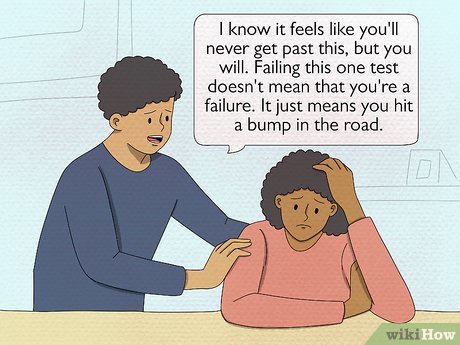
Failing an exam can feel heavy. It can make your heart sink, your motivation drop, and your mind fill with questions like “Am I not smart enough?” “What will others think?” “What do I do now?” Almost every student has faced this feeling at least once. And even though failure hurts, it does not mean the end of your journey. It does not define your intelligence or your future. Failing an exam is simply a sign that something in your learning strategy needs to change — not that you are a failure.
Let’s take a deep breath and talk about what to do next. Here is a step-by-step guide to turning a failure into a comeback.
1. Allow Yourself to Feel Disappointed — It’s Normal
When you get a low score or fail a test, it’s normal to feel upset. Don’t pretend everything is okay. Don’t force yourself to “get over it” instantly.
Take a little time to:
- Process your feelings
- Calm your mind
- Accept what happened
Talk to someone you trust — a sibling, parent, or friend. Sometimes simply expressing your feelings lightens the load.
Just remember: This feeling is temporary. It will pass.
2. Don’t Label Yourself Based on a Result
One exam cannot measure:
- Your intelligence
- Your creativity
- Your potential
- Your value
- Your future success
Many great people in history failed exams:
- Thomas Edison failed multiple tests.
- Einstein struggled in school.
- Jack Ma got rejected from 30+ job applications.
Yet they succeeded because they kept trying.
So instead of saying:
“I failed the exam, so I am a failure,”
Say:
“I failed the exam. I will work on improving myself.”
One result cannot define your future.
3. Review What Went Wrong — But Do It Calmly
After your emotions settle, look back and analyze:
- Did you study regularly or only before the exam?
- Did you memorize instead of understanding?
- Were there distractions like phone, games, or noise?
- Did you sleep well before the exam?
- Did you manage your time properly during the test?
Understanding the cause is powerful because this is where change begins.
Write down your mistakes.
Seeing them clearly makes improvement easier.
4. Ask for Help — You Don’t Have to Do It Alone
Sometimes all you need is a bit of guidance.
You can ask:
- A teacher → to explain concepts more clearly
- A classmate → to help you practice
- A tutor → to support in difficult subjects
- A parent → to help organize your study routine
Asking for help does not mean weakness.
It means you are strong enough to choose growth.
5. Make a New Study Plan — A Better One
Failing an exam is usually a sign that your study method wasn’t effective.
Here’s how to fix that:
Break your study time into daily short sessions.
Studying 30 minutes every day is better than studying 5 hours only before exams.
Use active learning:
- Explain the topic in your own words
- Teach someone else
- Create flashcards
- Take small quizzes
- Write summaries
Solve past exam papers.
This improves confidence and speed.
Study harder topics first.
Don’t avoid them — face them early.
6. Remove Distractions While Studying
Phones, social media, and noise steal attention.
Keep your phone away during study time or use apps that block distractions.
Study in a quiet, clean space.
Even 30 minutes of focused study is more powerful than 2 hours of distracted study.
7. Take Care of Your Mental and Physical Health
When we are tired, stressed, or sleep-deprived, learning becomes harder.
So:
- Sleep at least 7–8 hours
- Drink enough water
- Avoid skipping breakfast
- Take small breaks while studying
A healthy mind learns faster.
8. Don’t Be Afraid to Try Again
One failure is not the end.
It is a checkpoint, not a full stop.
Great students are made through:
- Patience
- Practice
- Persistence
When you try again — with better habits — you not only pass the exam, you grow stronger as a person.
9. Use Failure as Motivation, Not as a Scar
Failure can do one of two things:
- It can pull you down
- Or it can push you forward
The choice is yours.
Instead of thinking:
“I couldn’t do it.”
Think:
“I will do better next time, and this time I know where to start.”
Let failure teach you, not defeat you.
10. Appreciate Yourself for Not Giving Up
The fact that you are reading this and thinking about improving means you are already stronger than failure.
Many people give up — but you are choosing to rise.
Small effort today becomes big success tomorrow.