
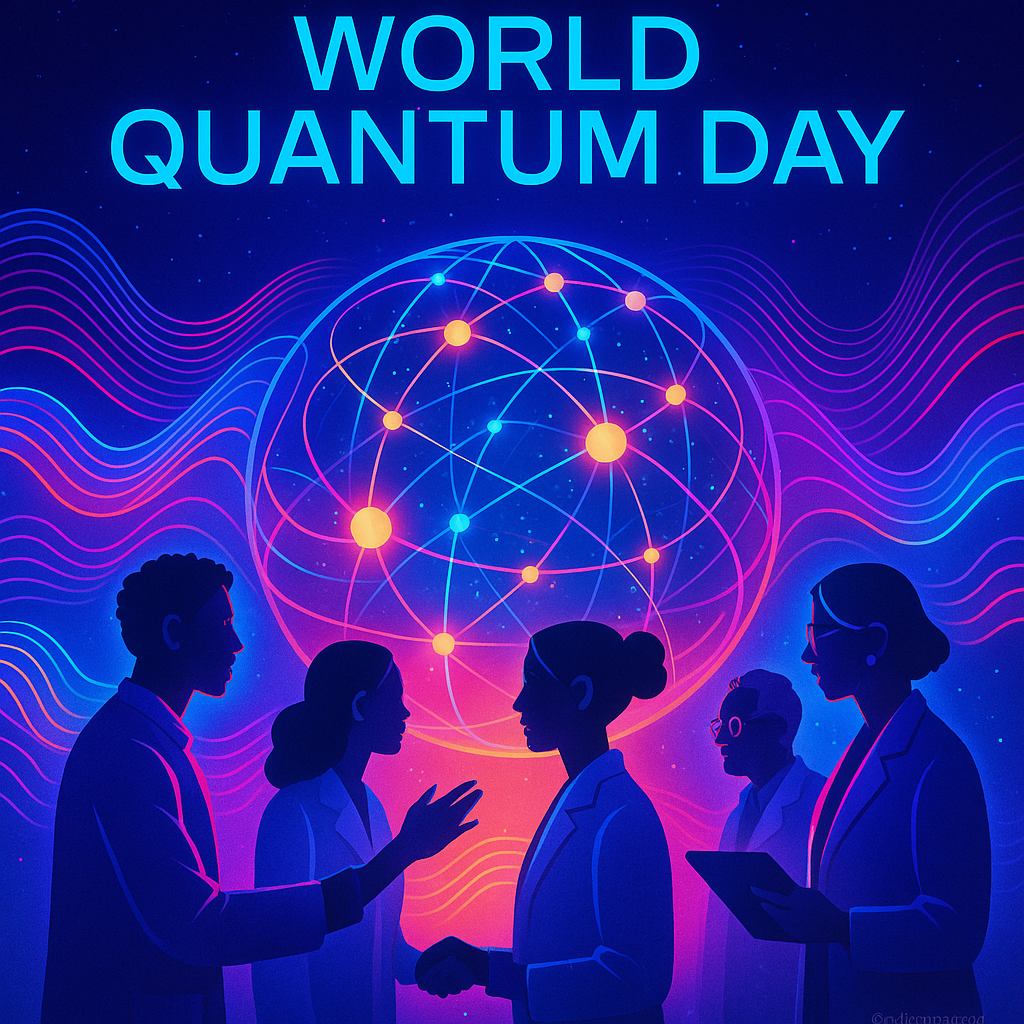
Every year on World Quantum Day, scientists, researchers, and technology enthusiasts come together to highlight one of the most complex and promising areas of modern science—quantum physics. This global observance is not just a celebration of science; it is a reminder of how quantum mechanics is shaping the future of technology, computing, communication, and even security systems.
World Quantum Day is observed annually on April 14, symbolizing the importance of quantum science in modern innovation. The date itself is inspired by the digits of Planck’s constant (4.14), which is a fundamental value in quantum physics. On this day, universities, research centers, and tech organizations host events, lectures, and demonstrations to explain quantum concepts in simple ways and to inspire future generations.
What is Quantum Technology?
At the core of this movement is the field of quantum science, particularly Quantum Computing. Unlike traditional computers that process information in bits (0s and 1s), quantum computers use quantum bits or “qubits.” These qubits can exist in multiple states at the same time due to a property called superposition. This allows quantum computers to perform extremely complex calculations much faster than even the most powerful classical supercomputers.
Another important principle is entanglement, where particles become interconnected in such a way that the state of one instantly affects the other, regardless of distance. These strange but powerful properties are what make quantum technology revolutionary.
Why Quantum Technology Matters
Quantum technology has the potential to transform almost every industry. In medicine, it could help simulate molecules to develop new drugs faster. In finance, it can optimize large-scale trading systems and risk analysis. In logistics, it can improve route optimization for global supply chains. In cybersecurity, however, it presents both opportunities and risks.
One of the biggest concerns is that quantum computers could break traditional encryption systems. This is why researchers are also working on quantum-safe encryption methods to protect data in the future.
The Rise of Future Tech Driven by Quantum Science
Quantum computing is just one part of a larger wave of “future technologies” that are shaping the digital world. Artificial intelligence, blockchain, advanced robotics, and quantum systems are increasingly interconnected.
AI systems, for example, may one day run on quantum computers, allowing them to process massive datasets in seconds and make highly accurate predictions. This combination of AI and quantum computing is often referred to as the next big leap in technological evolution.
Tech giants and research labs are investing heavily in this field. Companies like IBM, Google, and Microsoft are building quantum processors and cloud-based quantum platforms that allow researchers around the world to experiment with quantum algorithms.
Challenges in Quantum Development
Despite its potential, quantum technology is still in its early stages. One of the biggest challenges is stability. Qubits are extremely sensitive to environmental changes like temperature and vibration, which makes them difficult to control.
Another challenge is scalability. Building a quantum computer with enough stable qubits to outperform classical systems on a large scale is still a major scientific hurdle. Researchers are working on error correction techniques and better hardware designs to overcome these issues.
Global Interest and Education
World Quantum Day plays a key role in spreading awareness about this complex field. Educational institutions use this opportunity to simplify quantum concepts for students and the general public. Interactive workshops, online lectures, and science exhibitions help people understand how quantum physics is not just theoretical but also practical and future-focused.
Many countries are also introducing quantum research programs at university levels to prepare a skilled workforce for the future. Governments recognize that quantum technology will be a key driver of economic and technological power in the coming decades.
Future of Quantum Technology
The future of quantum technology is both exciting and unpredictable. Experts believe that within the next decade, we may see the first practical quantum advantage in real-world applications. This means quantum computers will outperform classical computers in specific tasks such as drug discovery, climate modeling, and cryptography.
As research continues, quantum technology is expected to merge with other innovations like AI, 5G/6G networks, and advanced sensors. This combination could lead to breakthroughs that are currently unimaginable.
Conclusion
World Quantum Day is more than just a scientific celebration—it is a global reminder that we are entering a new era of technology. With the rapid progress in Quantum Computing, humanity is moving closer to solving some of the most complex problems in science, medicine, and engineering.
While challenges remain, the potential of quantum technology is enormous. As research continues to advance, the world stands on the edge of a technological revolution that could redefine computing, communication, and intelligence itself.












Leave a Reply